 Rentron
What Is TRON Energy? A Practical Guide for TRC-20 Transfers
Learn what TRON Energy is, why USDT TRC-20 transfers consume it, how accounts obtain it and why the required amount can change.
In short
TRON Energy measures the computation used by smart contracts. A TRC-20 transfer calls a contract, so the sending address needs Energy or enough TRX to cover the missing resource.
Why this matters
Understanding the resource model explains why a wallet can hold enough USDT yet still need Energy or TRX to send it.
Original evidence
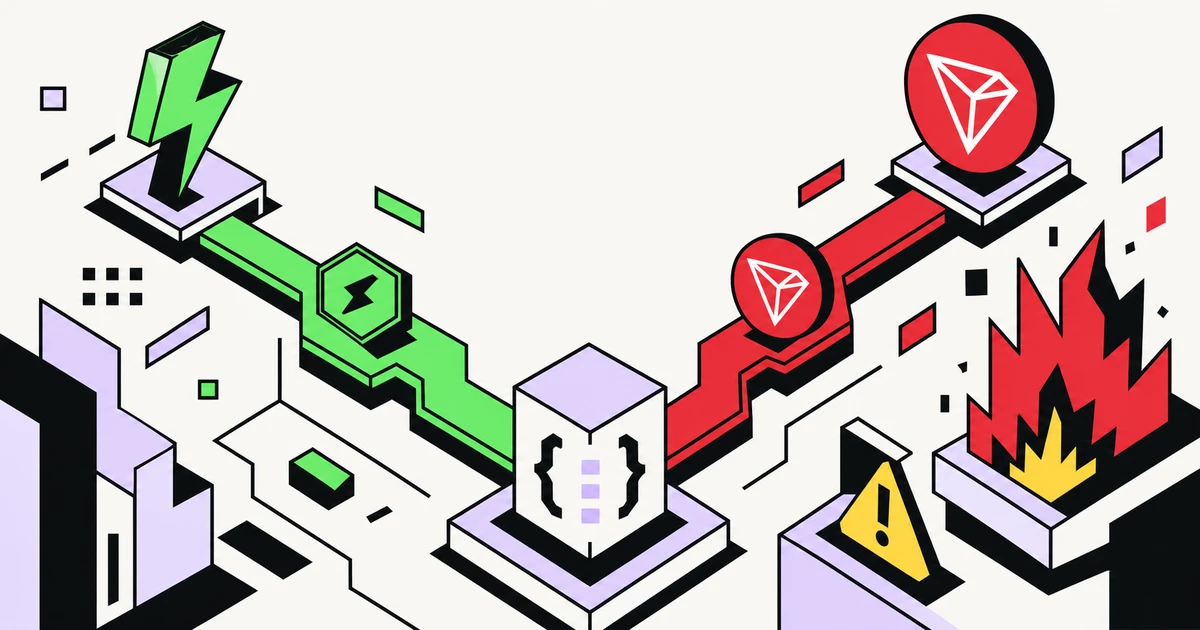
Resource-state map from transaction type to consumed TRON resource
Methodology: Compared native transfer and smart-contract execution rules in the TRON resource model, then mapped staking, delegation, consumption and burn fallback to the account that signs the call.
What is TRON Energy? It is the resource that measures computation when the TRON Virtual Machine executes a smart contract. TRON separates that work from the Bandwidth used for transaction bytes.
That distinction is important for anyone sending USDT or another TRC-20 token. A token transfer is not the same operation as moving native TRX. It calls the token contract, changes contract storage and therefore consumes computation.
Energy and Bandwidth solve different problems
The TRON resource model separates two common costs:
- Bandwidth measures the transaction data stored and transmitted by the network. In simplified terms, more transaction bytes require more Bandwidth.
- Energy measures the computation performed by the TVM while executing a smart contract.
A TRC-20 transfer uses both transaction data and contract computation. Bandwidth covers the first part; Energy covers the second.
This is why a wallet can have enough USDT to send but still require TRX or delegated Energy. The token balance and the network-resource balance are different things.
What happens when the sender has no Energy
TRON uses the sending account's available Energy first. If that resource is insufficient, the network can burn TRX to cover the caller's remaining share of the execution cost.
The transfer is therefore not necessarily blocked merely because the account has no delegated Energy. The economic result changes instead: the sender pays for the missing resource with TRX, subject to the transaction's fee limit and current network parameters.
Delegating Energy before the transfer is a way to prepare the resource separately from the token transaction. It does not move the USDT, change the recipient or sign the transfer on the user's behalf.
How an account obtains Energy
The protocol allows Energy to be associated with an account through TRX staking and resource delegation. Services can also coordinate temporary delegation from resource providers.
For the sender, the practical question is not where every unit originated. The important checks are:
- Is Energy available on the address that will sign the contract call?
- Is the amount sufficient for the actual transaction?
- How long will the delegation remain available?
- Can the result be verified from the account's resource state on-chain?
Rentron is designed around those checks: the user identifies the sending address, reviews an order and receives a resource delegation that can be independently observed on TRON.
Why the required amount is not permanently fixed
It is tempting to treat a familiar number as a universal fee. That is unsafe.
The amount used by a TRC-20 call can change because of the contract operation, the recipient's current storage state and TRON's dynamic Energy model. A recipient receiving a token for the first time can require a different storage update from an address whose token balance is already non-zero.
Popular contracts can also carry a dynamic energy_factor. The same method can therefore consume a different amount at another time even when its visible inputs look similar.
For a practical calculation, use an estimate for the concrete contract call and keep a safety margin. The guide on estimating Energy for a USDT transfer explains that workflow.
What Energy does not do
Energy is not:
- a replacement for the USDT being transferred;
- a custodial balance controlled like a token;
- a guarantee that a malformed or reverting contract call will succeed;
- a permanent universal quota for every future transaction.
It is one resource consumed during contract execution. The transaction still needs a correct signature, valid parameters, sufficient token balance, Bandwidth and an appropriate fee limit.
The practical takeaway
Think of Energy as prepared computation for the sending address. Before a TRC-20 transfer, estimate the contract call, check the address's existing resource balance and cover the expected deficit. After delegation, verify the resource state before signing the token transaction.
That workflow is more reliable than memorizing one number or discovering the cost only after submitting a transfer.
Is TRON Energy a token or a wallet balance?
Energy is not a TRC-20 token and has no token contract address. You cannot send it with a token transfer, swap it on a DEX or withdraw it to another network. It is an account resource recorded by TRON and consumed when the TVM executes instructions.
Wallet interfaces often display Energy beside asset balances, which can make the distinction unclear. The asset balance answers “how many tokens does this address own?” The resource state answers “how much contract computation can this address currently cover before TRX burn is needed?”
Delegation changes the resource available to an address without transferring ownership of the delegator's TRX. It also does not give the delegator authority over the recipient wallet. The article is TRON Energy rental safe maps this protocol boundary to the wallet permissions a provider cannot receive.
How is Energy obtained and used?
An account can obtain Energy by staking TRX for that resource. Under TRON's staking model, an account with resource capacity can also delegate Energy to another existing account. The recipient then uses the resource for its smart-contract calls during the applicable period.
For one transfer, the lifecycle is observable:
- Estimate the caller's Energy requirement.
- Read the sender's existing available Energy.
- Stake or receive delegation for the deficit.
- Confirm the new resource state on the sender.
- Sign and broadcast the TRC-20 transaction.
- Read the receipt to see actual consumption.
Consumed Energy does not disappear permanently from staked capacity; it recovers according to the network resource model. Delegated capacity may also be reclaimed by its owner when protocol and rental timing allow. That is why availability must be checked for the moment of execution.
Why does USDT use Energy but TRX usually does not?
USDT on TRON follows the TRC-20 contract interface. A transfer calls transfer(address,uint256), executes TVM instructions and writes token balances in contract storage. Those computations consume Energy.
A basic native TRX transfer does not execute the USDT contract. It still creates transaction bytes and therefore uses Bandwidth, but Energy is not the primary resource for that operation. A more complex TRX-related smart-contract call can consume Energy because transaction purpose alone does not determine the resource; execution type does.
This distinction is useful when a wallet reports a fee. Ask whether it is moving native TRX or invoking a contract. “A transfer on TRON” is too broad to predict Energy use.
How can you read an account's Energy?
TRON exposes account resource data through wallet/getaccountresource. The relevant fields are EnergyLimit and EnergyUsed:
Available Energy = max(0, EnergyLimit - EnergyUsed)
If the fields are absent, treat the values as zero. Read the address that will sign and broadcast the call, not the token recipient. The Energy balance guide includes a request example and checks for confirming a new delegation.
The value is time-dependent. Another contract call can increase EnergyUsed; recovery can lower it later. An explorer page or API response captured hours ago cannot prove that the same amount is available now.
Why can the required Energy change?
TVM instruction cost depends on what the contract executes. For TRC-20 transfers, storage writes are especially important. TRON's FAQ explains that changing a zero storage value to a non-zero value costs more than updating an existing non-zero value. A first receipt of a token can therefore differ from a later receipt.
TRON also applies a dynamic Energy model to heavily used contracts. Each contract can have an energy_factor that adds consumption above the base execution. The factor changes with network maintenance cycles and contract resource use.
These two effects make fixed-number claims fragile. A package can use a fixed order unit, but the network's actual requirement remains variable. Use a concrete simulation when exact sizing matters.
What happens when Energy is insufficient?
TRON consumes available Energy first. If it does not cover the caller's share, the protocol can burn TRX for the remainder. The transaction's fee_limit caps the amount the caller permits for execution. Too little TRX or an inadequate fee limit can contribute to OUT_OF_ENERGY failure.
More Energy does not repair a reverting call, wrong contract, invalid recipient encoding or insufficient USDT balance. It only covers computation. Diagnose the receipt before ordering more resource after a failed transaction; the USDT failure guide separates these causes.
Summary
What is TRON Energy? It is the network resource that measures computation performed by the TRON Virtual Machine. Smart-contract transactions consume it; a USDT TRC-20 transfer is a contract call, so the sending address needs enough Energy or enough TRX to cover a resource deficit.
Energy differs from Bandwidth. Bandwidth covers transaction bytes, while Energy covers contract execution. It also differs from a token balance: Energy has no token contract, cannot be swapped and does not move as USDT does. Accounts obtain it through staking or receive it through resource delegation.
The requirement is not permanently fixed. Recipient storage state and a contract's dynamic energy_factor can change the cost of the same visible operation. Read EnergyLimit and EnergyUsed on the exact sender, estimate the intended call, cover the deficit and verify the resource again before signing.
If Energy is insufficient, TRON can burn TRX for the uncovered caller share, within the fee limit. That fallback does not guarantee success when the call itself is invalid. Rentron lets a user fund a permanent TRON deposit address, review the complete order price and delegate Energy to a public sending address without sharing wallet secrets. Delivery is checked on-chain. For a concrete workflow, continue with how to estimate Energy for USDT.
Comparison
| Resource | Pays for | If insufficient |
|---|---|---|
| Energy | Smart-contract computation | TRX may be burned |
| Bandwidth | Transaction bytes | TRX may be burned |
| TRON Power | Voting rights | No transaction execution role |
When TRON Energy is not the right choice
- If you send native TRX, Energy is not the primary resource; inspect Bandwidth instead.
- If a custody provider sends from its own wallet, you cannot prepare resources on the provider's hidden sending address.
- If you only read contract state without broadcasting a transaction, a constant query does not consume on-chain Energy.
Frequently asked questions
Is TRON Energy a token?
No. Energy is a network resource associated with a TRON account, not a transferable TRC-20 token balance.
Does a normal TRX transfer consume Energy?
A basic TRX transfer primarily consumes Bandwidth. Energy is used for smart-contract execution, including TRC-20 transfers.
Which account needs Energy for a USDT transfer?
The account that signs and sends the TRC-20 transaction needs the resource.
Can the Energy requirement change?
Yes. Contract state, recipient storage state and the dynamic Energy factor can change consumption.
Primary sources
- TRON Developer Hub — Resource Model· Primary· 2026-07-12
- TRON Developer Hub — Energy Consumption Mechanism· Primary· 2026-07-12